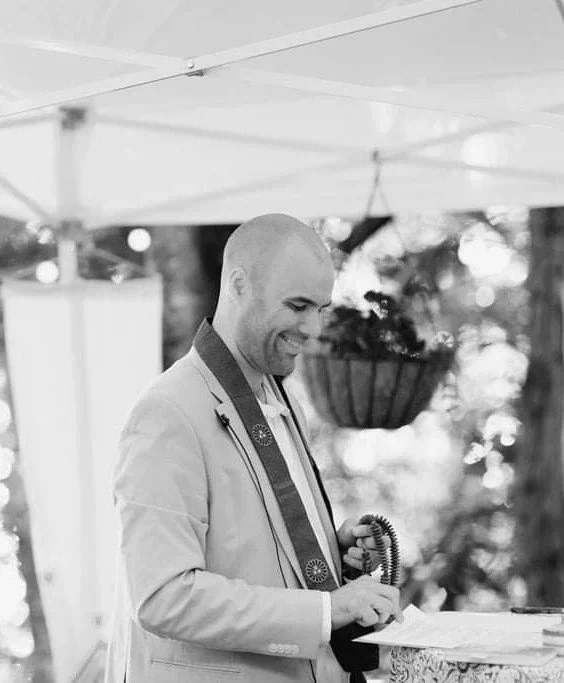
About Me
I have spent my professional life in between institutions, communities and cultures. Between elected leaders and the communities they serve and regulate. Between helping professionals and the people who control their resources. Between public institutions and contemplative practice. Between the country where I was raised and the one where I am now building a life— in the Dutch city of Maastricht, with my wife and three sons. Living as an American expat in Europe has given me an unusually close relationship with the question my work with clients often returns to: who are you when the context that shaped you no longer surrounds you? For many years, I thought I was at the margins of both influence and the deeper insights that would allow me to help others. I have come to realize that this in-between state puts me at the center of something powerful.
Operating across traditions rather than inside one produces a particular kind of clarity: the ability to see what each framework can't see about itself, and to synthesize what none of them produces alone. Most of that formation happened inside public service institutions: formulating budgets, developing performance standards, designing organizations, aligning aspirations to bureaucratic realities. Alongside that, years of Buddhist practice leading to ordination as a soryo (priest) in the Tendai Buddhist tradition, a Master of Divinity in Buddhism and spiritual care, and training in a Korean lineage of BaZi. None of those credentials belong to the same world. My strength is finding the unifying thread —the inner architecture—across these realms.
BaZi entered because I needed a tool precise enough to be genuinely useful. I had frameworks for understanding organizations and frameworks for understanding suffering. What I lacked was a framework for understanding the specific person in front of me — their constitutional makeup, their characteristic patterns, why this particular person kept running into this particular wall. The Korean lineage of BaZi that I have studied, with an emphasis on Wu Yun-Liu Qi theory, gave me that.
The vow at the center of my ordination is to work to relieve suffering through whatever means available. That vow is the organizing principle of everything I do professionally. The aspiration behind every engagement is that you leave with a clearer, more honest account of yourself than you arrived with.